Showing posts with label access. Show all posts
Showing posts with label access. Show all posts
Monday, May 29, 2017
Deny Access Through htaccess
Deny Access Through htaccess
Each website owner must take the time to learn the value of using .htaccess. It allows you to customize your site so that it performs optimally throughout all of its applications. One of the ways in which it helps you to run your website much more effectively, is that it enables you to deny access to key areas within the site itself. So, why is this important? For starters, profane website contributors on blogs can cause unrest among your more loyal followers. Also, you need to understand how to deny access to key areas such as administrative sections so that the website cannot be altered without your permission. Denying access prevents “bad bots” from taking hold, and it can deny visitors by referrers.
 |
| Deny Access Through .htaccess |
If you own a website, then you should be the only one who gets to access administrative areas within the site. If you do not block access, then your webpages can be changed for the worse. Spamming becomes more of a problem under this circumstance as well. Unwanted emails designed to steal personal information are easier to attain when areas of your website grant access to all. People who are unfamiliar with the ways in which spammers work, are often the victims. These same people then unwittingly spread the harmful spam to others.
A profane website visitor not only has the ability to deter legitimate people from using your site, but also the ability to bring negative publicity. Many people owe a great deal of their business success to the opportunities that online ventures afford. It is this potential financial success that sometimes makes people drop their guard, thus allowing profane visitors to proliferate their message. Even though you might not endorse their controversial statements, they will still ward off people that you need in order to remain successful.
Sometimes people try to hack your website by stealing your password and personal identifying information. When this occurs, you must deny access through .htaccess. For example, if you find that one particular webpage becomes compromised more than others, then you must revamp that page or get rid of it altogether. Often, immediately denying access to an offending hacker will allow you to establish a rep for not being easily accessed by criminals.
Programs which visit other websites to steal content, find security weaknesses, and source email addresses, are called bad bots. Bad bots scan a site to procure email addresses, for example. Those email addresses are then used in order to send out mass spamming emails. Most of these contain legitimate-looking business names, and they make realistic requests for money or information.
The elderly are particularly susceptible to this issue because they might forget how to scan for the issues. More serious, however, is the bad bot’s ability to locate security holes by testing different aspects of the website discreetly. Once the security holes are identified, personal information can be stolen with ease. Use .htaccess to deny access to aspects of the site which contain sensitive information. For detailed ways to deny traffic through .htaccess read the post Htaccess Deny From All.
Go to link for download

Monday, May 1, 2017
New Special Access Rules Could Lower Frontier Revenue Modestly
New Special Access Rules Could Lower Frontier Revenue Modestly
Lower price caps for special access services (“business data services”) will be the result of proposed Federal Communications Commission rules. The moves will mean lower prices for enterprises and service providers who do not own fixed network assets, and lower revenues for firms with such assets.
AT&T will suffer the most, with Verizon, CenturyLink and Frontier Communications also losing revenue.
The proposed rules call for a one-time downward adjustment of 11 percent, phased in over three years, beginning in July 2017 (three percent in year one, four percent in year two, and four percent in year three).
As always, there are trade-offs. Enterprises will get rate relief. But lower investment in new facilities will happen, says Zacks Equity Research.
Though Frontier Communications once argued the FCC rules would not affect its revenue, Frontier now estimates the rules, if implemented on July 1, 2017, will have a revenue impact of approximately $10 million in 2017, $20 million in 2018 and 2019, with subsequent annual impacts declining after that.
Some estimate the rules will reduce overall industry revenue by $1.6 billion or so, per year.
The Communications Workers of America also anticipates lower investment and lower revenue will mean lost jobs as well.
Perhaps the biggest long-term impact will be felt by cable TV operators who supply such services, as the new rules appear to bring the cable TV industry into the framework for the first time.
The FCC has received confidential information on service provider revenues, without releasing that information, so it is difficult to predict precisely how much revenue might be affected the proposed rules, beyond what Frontier estimates.
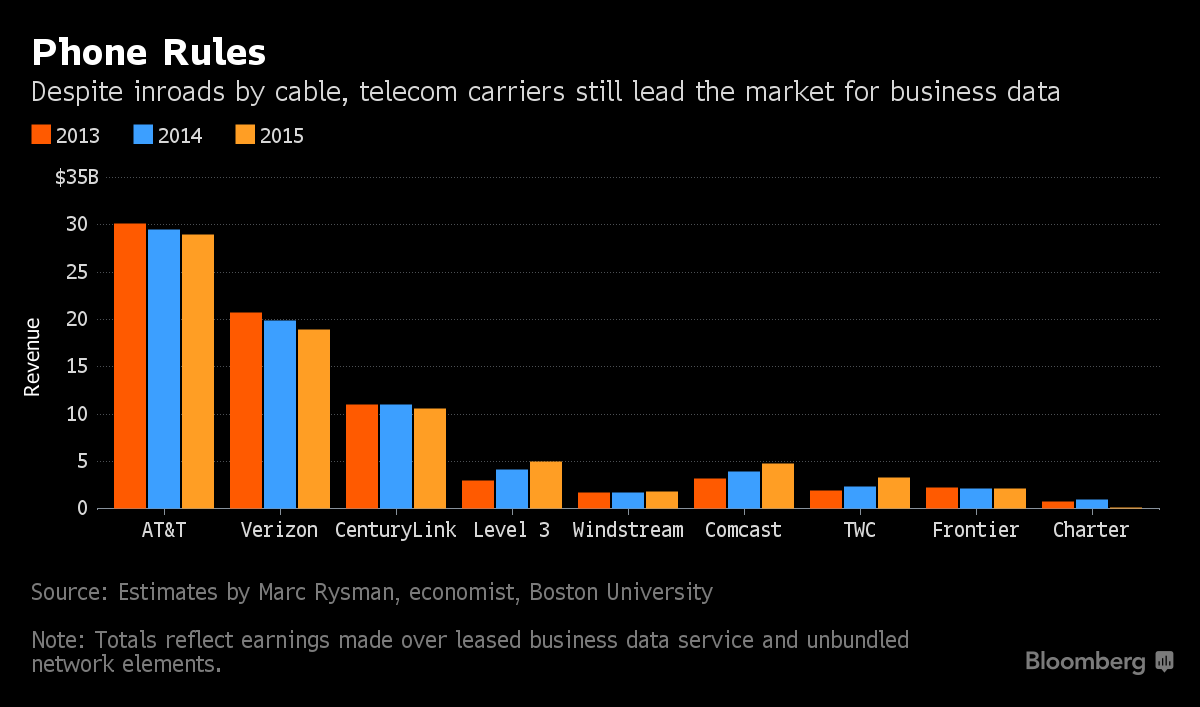
source: Bloomberg
Go to link for download
Thursday, April 20, 2017
Average U S Internet Access Speeds are Highly Dynamic
Average U S Internet Access Speeds are Highly Dynamic
If in the second quarter of 2016, average connection speeds in U.S. cities ranged from 17 Mbps to 24 Mbps, while Internet service providers are selling gigabit access, as well as services in the 100 Mbps to 300 Mbps range, it is obvious that most consumers are not buying either gigabit or hundreds-of-megabits services.
On the other hand, speeds are increasing rapidly. In fact, according to Okla, fixed network customers in the first half of 2016 got an average of over 50 Mbps for the first time ever.
That represents a speed improvement of more than a 40 percent since July 2015.
Similarly, mobile Internet access customers saw speeds improve by more than 30 percent since last year, with an average download speed of 19.27 Mbps in the first six months of 2016.
In other words, by some measures, mobile Internet access download speeds are as fast, or nearly as fast, as the “average” U.S. fixed network connection in at least some cities.
Just as important are http://tylercaldwellphotography.blogspot.com /2016/08/over-15-years-average-internet-speed.html" style="text-decoration: none;">speed differences between various ISPs. Where Google Fiber might offer an average speed in excess of 300 Mbps, Comcast and other cable TV ISPs might average about 50 Mbps to 45 Mbps. Telcos tend to deliver slower speeds than that, with the exception of Verizon FiOS, which has an average speed of about 50 Mbps.
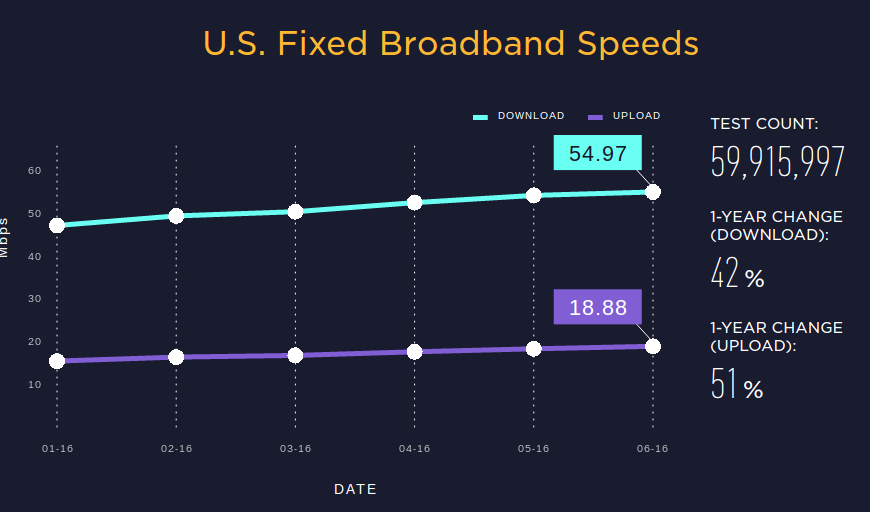
source: Ookla
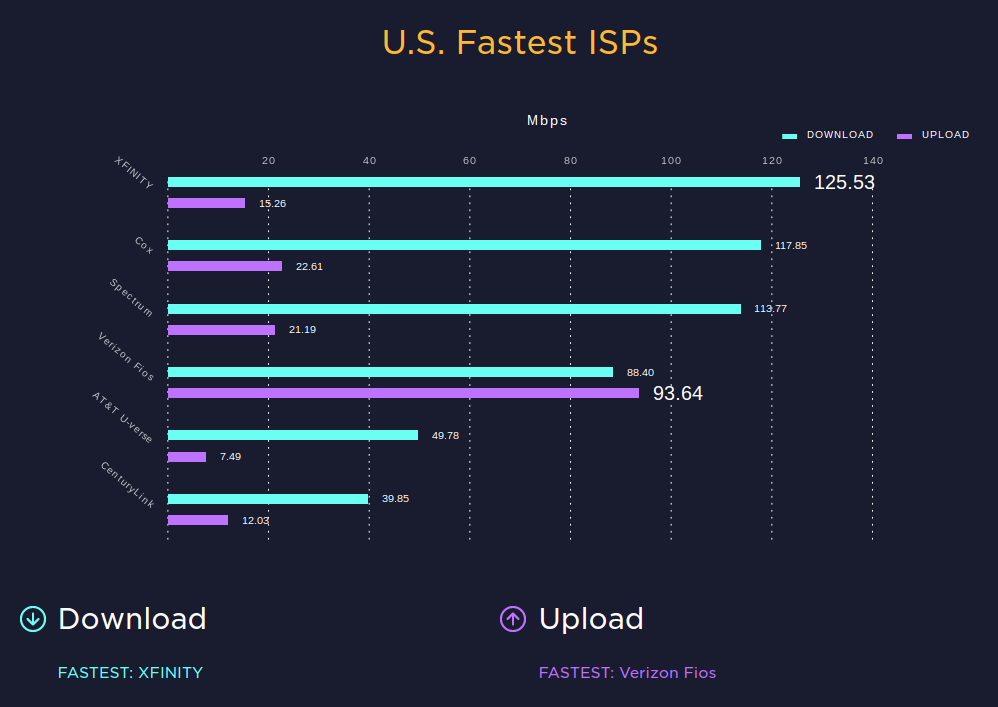
source: Ookla
Go to link for download
Subscribe to:
Posts (Atom)